Preventive Care
Cleanings, exams, digital x-rays, sealants and gum health monitoring that catch small problems while they are still small.
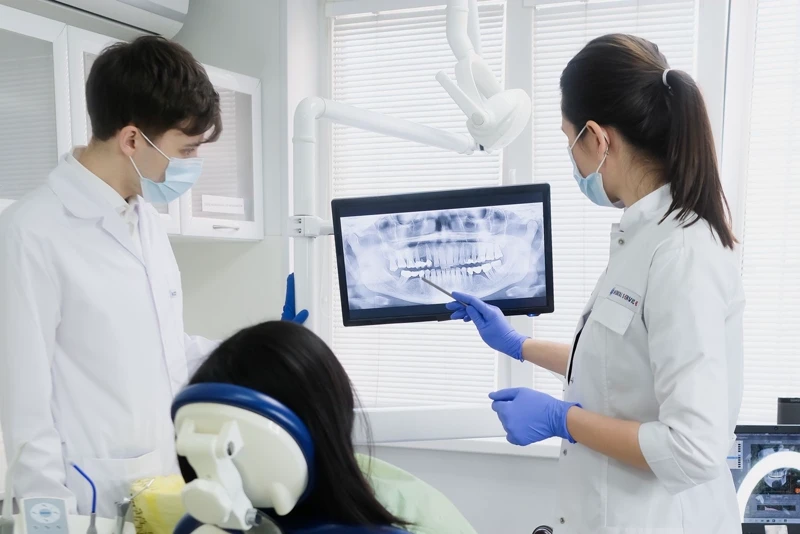
Preventive care is the least dramatic thing we do and by a wide margin the most valuable. Almost every expensive dental problem started as a cheap one that nobody caught. A filling costs a fraction of a crown. A crown costs a fraction of an implant. The entire argument for coming in twice a year is that the gap between those numbers is enormous and the appointments that prevent it are short.
What a hygiene visit actually involves
We schedule fifty minutes for a routine hygiene appointment. That is longer than is typical, and it exists so that nothing has to be hurried. In that time your hygienist will remove hard deposit above and below the gum line with both ultrasonic and hand instruments, polish the surfaces, floss properly between every contact, and apply fluoride varnish if it is indicated.
Before any of that happens, she will measure your gums. Six readings per tooth, recorded, so that we have a real baseline rather than an impression. Gum disease is largely painless until it is advanced, which is exactly why measuring beats guessing. If a pocket that read three millimetres last year reads five this year, that is a signal worth acting on while it is still reversible.
Examinations
A dentist examines you at least once a year, and in most cases at every second hygiene visit. That examination covers every tooth surface, every existing filling and crown, the bite, the jaw joint, and the soft tissues. The soft tissue part is an oral cancer screening and it takes about ninety seconds. Oral cancers found early have dramatically better outcomes than those found late, and the screening costs nothing extra.
Digital x-rays
We use digital sensors rather than film. The radiation dose is roughly eighty percent lower than the film systems many people remember from childhood, and the image appears on the screen beside you immediately, which means we can show you what we are talking about rather than describing it.
Bitewing x-rays, which show decay between teeth where it cannot be seen directly, are usually taken once a year for adults with a history of decay and less often for those without. We do not take images on a fixed schedule regardless of need. If you have had no decay in a decade, you do not need the same imaging frequency as someone who has.
Sealants
The chewing surfaces of back teeth have deep grooves that a toothbrush bristle is physically too wide to reach into. A sealant is a thin resin coating flowed into those grooves and set with a light. It takes a few minutes per tooth, requires no drilling and no anaesthetic, and substantially reduces decay in the surfaces most likely to get it. We recommend them for children as the adult molars come through, usually around six and again around twelve, and occasionally for adults with deep grooves and a history of decay.
How often should you come?
Twice a year suits most people. Some need three or four visits, particularly patients with a history of periodontal disease, smokers, diabetics, and people going through orthodontic treatment. A few genuinely low-risk patients do fine on an annual visit. We will tell you which category you are in based on what we actually find, and we will revisit that as things change rather than treating it as fixed forever.
If it has been a long time
If your last cleaning was years ago, you are not going to be lectured. That is a promise, and it is worth stating plainly because embarrassment keeps an enormous number of people out of the chair far longer than the original problem warranted. We will usually do the examination first, work out what is actually going on, and then plan the cleaning properly, sometimes across two visits if there is a lot to remove. Starting is the hard part. The rest is routine.